Search Here without leaving this page

Our Email Address --> greenlegacy05@yahoo.com

.

World Sunlight Map -Satelite View

Showing posts with label Pests Controls. Show all posts

Tuesday, May 6, 2008

Integrated Pest Management (IPM): Prevent Pests and Diseases

Integrated Pest Management (IPM): The prevention and control of pests and diseases
using all existing crop protection techniques and strategies:

Techniques and strategies that prevent pests and diseases:
1. Hygienic measures:*Start with clean seed and/or transplants. *Remove old plant material (source of disease inoculum and refuge for insects) from greenhouse and dispose of. *Solarization: increase the temperature set point in the greenhouse after the last crop is removed. This can kill harmful organisms on gravel, walls, tubing, etc.
*Remove weeds inside and outside the greenhouse (these can be hosts for insects and diseases for present and future crops). *Prevent transmission of pests/disease by humans/machines/tools. (“Hygiene coats” for guests; disinfect shoes/hands/tools.)

Note: Skimmed milk can encapsulate viruses on tools!

*Prevent transmission of pests/diseases in the irrigation water by filtering, UV radiation or ozone treatment.
2. Mechanical measures: *Use insect netting (several sizes specific to different insects) over
air intakes or vents to prevent entry. *Use a plastic or woven floor covering to isolate the plants from insect pests and diseases in the soil below.
3. Cultural practices: *Optimize plant growth: a healthy plant is a more resistant plant.
*Avoid plant damage (creates easy entry for disease). *Plant workers should move from clean to infested areas. *Although greenhouse hydroponic crops are planted at higher densities than field crops , too high of planting densities can result in thin, weak plants that are more susceptible to pests/diseases. *Maintain a regular harvest schedule – plants allowed to get over or under-loaded with fruit may become weakened. *Can use “crop rotation” – alternating host and non-host crops. This is not usually done in greenhouse hydroponics.
4. Genetic/transgenic/other control: *Use “resistant” or “tolerant” varieties. If growing “susceptible” varieties, grow during times of low infestations. *Note: There may be a trade-off between growing resistant or tolerant species/varieties and maintaining maximum yields.
*Can use plant material from tissue culture – disease free
.


Digg Technorati del.icio.us Stumbleupon Reddit Blinklist Furl Spurl Yahoo Simpy

Disadvantage Of Biological Control For Insects & Pests In A Greenhouse

There are some disadvantages for Hydroponic growers in order to implement Biological control method;

  • Biological control is an extremely “knowledge intensive” technique. Example: If white flies are discovered on tomatoes, the grower could spray… and that would be that. However, if biological control is used, the grower must first identify the type of white fly (Trialeurodes verses Bemisia) then order the appropriate beneficial wasp, then place the wasps in the proper locations in the crop…
  • Introduce the beneficial(s) BEFORE the pest organism is present. If the grower waits until the pest is noticed, populations are already rising and the lag time between noticing-ordering-introduction may be up to 2 weeks – plenty of time for a pest to get out of control! This is commonly done with white fly parasitic wasps.
  • There are natural “swings” in both the beneficial and pest populations. As the pest population rises there will be more food/hosts for the beneficial (predator/parasite) population which will begin rising. As the beneficial population rises and eats/parasitizes the pests, the pest population will decrease resulting in less food/hosts for the beneficials. As the beneficial population decreases the pest population rises again, etc.
There are 3 ways to introduce “beneficials” to a crop:
  1. Conservation: Attraction and preservation of naturally occurring beneficial organisms in the crop (best for field crops).
  2. Inoculation: Periodic releases of small numbers of “beneficials”starting early in the season. Used in greenhouse hydroponics.
  3. Inundation: Mass introductions of “beneficials” aimed at eliminating pests immediately, especially when pest populations are high.


Digg Technorati del.icio.us Stumbleupon Reddit Blinklist Furl Spurl Yahoo Simpy

Monday, May 5, 2008

Biological Control For Insects & Pests In A Greenhouse

Biological Control is the use of one organism (beneficial) to control another (pest). Often used to refer to beneficial insects such as wasps, bugs or mites that are used to control such pests as white flies, thrips or aphids. This term can also apply to parasitic bacteria, fungi and nematodes . *Note that there are at least 72 species of predators/parasites for 60 pest species.
Many growers, especially greenhouse hydroponic growers worldwide, began returning to biological control due to:the development of pesticide resistant pest populations
  • the high cost of pesticides
  • the difficulty in observing “harvest restrictions”, the delay time between application of pesticide and harvest
  • the reduction in yields due to phytotoxicity of the pesticides
  • the fact that DDT and other chemical pesticides were persistent in the environment and affected other species than those intended (i.e., DDT which caused thinning and brittleness of the eggs of the California Condor, death of the chicks, and decreased populations almost to the point of extinction)
  • the increased concern with exposure of greenhouse workers to pesticides and, for the consumer, of exposure to pesticide residues on the produce
  • the use of bumble bees in the greenhouse to pollinate the crop, especially tomatoes and peppers (see Chapter 6). Pesticides would not only kill the pest but the bees as well!
  • the fact that vegetables produced “pesticide free” command a higher price at the market!

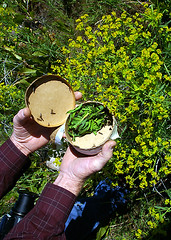
Insect Release on Leafy Spurge Releasing beneficial bugs on plants to control harmfull insects


Digg Technorati del.icio.us Stumbleupon Reddit Blinklist Furl Spurl Yahoo Simpy

Sunday, May 4, 2008

INSECT AND MITE PESTS - WHITEFLY

Whitefly

Whitefly - Trialeurodes vaporariorum (Greenhouse whitefly), Bemisia tabaci (Genn.) (Sweet Potato whitefly)
  • Appearance: (Insect) Both are white in color. Trialeurodes holds its wings out giving it more of a triangular shape, whereas Bemisia appears more linear.
  • Life cycle: Essentially 7 stages: Egg: on a stalk on the leaf underside, sometimes with several in a circle. 4 larval stages: initially with legs, but lose their legs after they pierce the leaf tissue and begin to feed. Pupal (or false pupa) stage: sedentary stage; adult red eye color appears. Adult: emerges from the pupa. This stage also feeds.
  • Damage: Larvae and adults pierce and suck juices from plant cells causing reduced photosynthesis and growth, leaf drop and reduced harvest. Larvae and adults excrete honeydew onto leaves and fruit. Molds colonize the honeydew reducing photosynthesis and transpiration on leaves and leaving sticky, “dirty” deposits on fruit (unmarketable).Both whiteflies have been shown to transmit viruses (see Viruses below).
  • Control/Natural enemies: Parasitic wasps: An egg is laid in the whitefly larvae (3rd or young 4th stages preferred). The egg hatches and the wasp larvae devours the whitefly larvae, then uses the host’s shell to develop to adult which emerges through a small round hole in the host’s shell. The wasp Encarsia formosa prefers the whitefly Trialeurodes. Upon entry the wasp larvae turns the w.f. pupa black. The wasp Eretmocerus eremicus prefers the whitefly Bemisia. Upon entry the wasp larvae turns the w.f. pupa golden. Verticillium lecanii: A fungus that parasitizes and ultimately kills whitefly


Digg Technorati del.icio.us Stumbleupon Reddit Blinklist Furl Spurl Yahoo Simpy

INSECT AND MITE PESTS - THRIPS

Thrips (Thrips tabaci, T. fuscipennis and Frankliniella occidentalis): *Appearance: 6 legs (smallest of the winged insects); long and narrow; tan.
*
Life cycle: 6 stages:
Egg - laid inside the leaf surface, flower petals or soft stems – causes small warts on sweet pepper leaves.
2 larval stages – these are very active and feed on all aerial parts of the plant. After these stages they drop to the ground and pupate.
2 pupal stages – these stages do not feed. Wing stumps begin to form. Adult – has two pairs of wings. Young thrips resemble adults in shape but are yellow in colour and wingless. Adult males are pale yellow in colour; females vary from pale yellow to dark brown and are larger than males.
BODY LENGTH: Adult - 1.2 mm; Mature nymph- 1.0 mm. .

*Damage: Larvae pierce and suck out cell contents; cells die and turn silvery gray. Loss of chlorophyll; decreased photosynthesis; brittle leaves. Black spots appear – these are the excrement of the thrips. Also damage to fruit (tomatoes, cucumbers, peppers) and flowers.
Tomato Spotted Wilt Virus: is acquired by the larvae during feeding on infected plants but TSWV is transmitted exclusively by the adults.
*
Control/Natural enemies:
Predatory mites (Amblyseius barkeri and A.cucumeris) eat thrips. They are shipped in “sachets” with “grain mites” (plant/fungus feeders and food for the beneficials to eat during shipping). Hang sachets in the crop for a max. of 2 weeks and then removed to avoid grain mite
infestation on the plants. (Grain mites: see Eriophyid mites below) Predatory bugs of the genus Orius with flattened bodies and protruding mouth parts for sucking the juices from the thrips body.

Verticillium lecanii: a fungus that parasitizes and ultimately kills thrips.This fungus does not harm other natural enemies of the thrips.

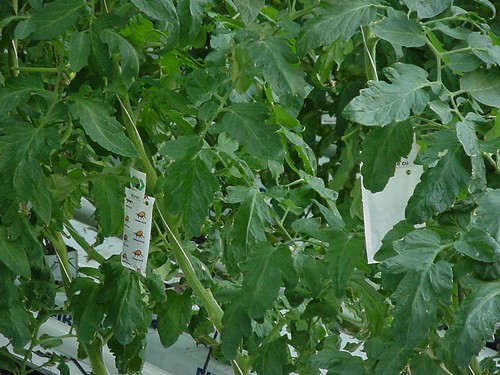
The impact of Thrips attack on plants and crops. Tomato plants is Thrip's favourites


Digg Technorati del.icio.us Stumbleupon Reddit Blinklist Furl Spurl Yahoo Simpy

Saturday, May 3, 2008

INSECT AND MITE PESTS 2 - Red Spider Mites


Red spider mites (Tetranychus urticae and T. cinnabarinus):
*
Appearance: 8 legs (spider family); ovoid bodies; variable color (green, yellow,
orange and black but reddish brown when feeding on tomatoes).
*
Life cycle: 5 stages: egg, larva, first nymphal (6 legs), second nymphal, adult.
Time in each stage depends on temperature (~30C/86F is optimal).
The population = 75% females, 25% males.
*
Damage: Larvae, nymphs and adults pierce plant cells and suck out the contents usually from the under side of leaves. Chlorophyll is destroyed leaving yellow patches and photosynthesis decreases. These patches are a major problem on ornamentals. Nymphs and adults produce webbing which are swarming with mites and give the leaf a reddish hue.
*
Control/Natural enemies: Dusting sulfur is an effect miticide. DO NOT dust beneficial mites or bees. The predatory mite (Phytoseiulus persimillis): Belongs to the same order as the red spider mite – Acarina. Nymphs and adults eat spider mites. Feeding depends on populations, temperature and humidity.


Digg Technorati del.icio.us Stumbleupon Reddit Blinklist Furl Spurl Yahoo Simpy

Friday, May 2, 2008

INSECT AND MITE PESTS - APHIDS

Aphids?Aphids
Insects and mites can cause physical damage to plants, or transmit toxins, bacteria, fungi or viruses from plant to plant. CEA can help exclude many insects and mites from the greenhouse environment. The closed nature of the greenhouse in conjunction with insect screening on vents and air intakes can create an effective barrier. However, the greenhouse environment coupled with the typical monoculture that is grown there can create a perfect breeding ground for insects and mites that do manage to get in and population explosions can occur quickly.

Many insects and mites harm plants. However, several groups are of major concern in
CEA/hydroponics. If not monitored closely and controlled immediately,
populations of pests can explode quickly and devastate a crop.

1). Aphids (several genera):
*
Appearance: 6 legs/insect, round body, several colors (white, green, tan, black).
*
Life cycle: Complicated: reproduce asexually in summer, sexually in winter.
Young born complete (miniature adults) and molt 4 times. White “cast skins” indicate the presence of molting young. Can be wingless or winged if populations high or when changing hosts. Mainly produce females (except in winter for sexual reproduction). High growth rate: 40-100 larvae/aphid (3-10/day over a few weeks).
*
Damage: Young and adults suck plant sap (high in sugar); plant growth is reduced,
and leaves curl upward. Excess sugar is excreted as honeydew that drops onto lower leaves;
sooty molds colonize the honeydew and reduce photosynthesis. Toxic substances can be injected. Pathogens (esp. viruses) can be transmitted (mainly by winged adults).
*
Control/Natural enemies: Gall-midge (Aphidoletes aphidimyza): same family as flies, mosquitoes. Gall-midge larvae inject poison that paralyzes and liquefies the aphid’s insides which can then be drained. Parasitic wasps (Ex. Aphidius matricariae): The wasp lays an egg on the aphid which then swells and hardens (“mummy”). After growth, the adult wasp leaves the mummy through a circular hole. Verticillium lecanii: A fungus that parasitizes and ultimately kills aphids. Ladybird Beetles or lady bugs (Hippodamia convergens) and Lacewings
(Chrysoperla carnea) also provide control of aphids.


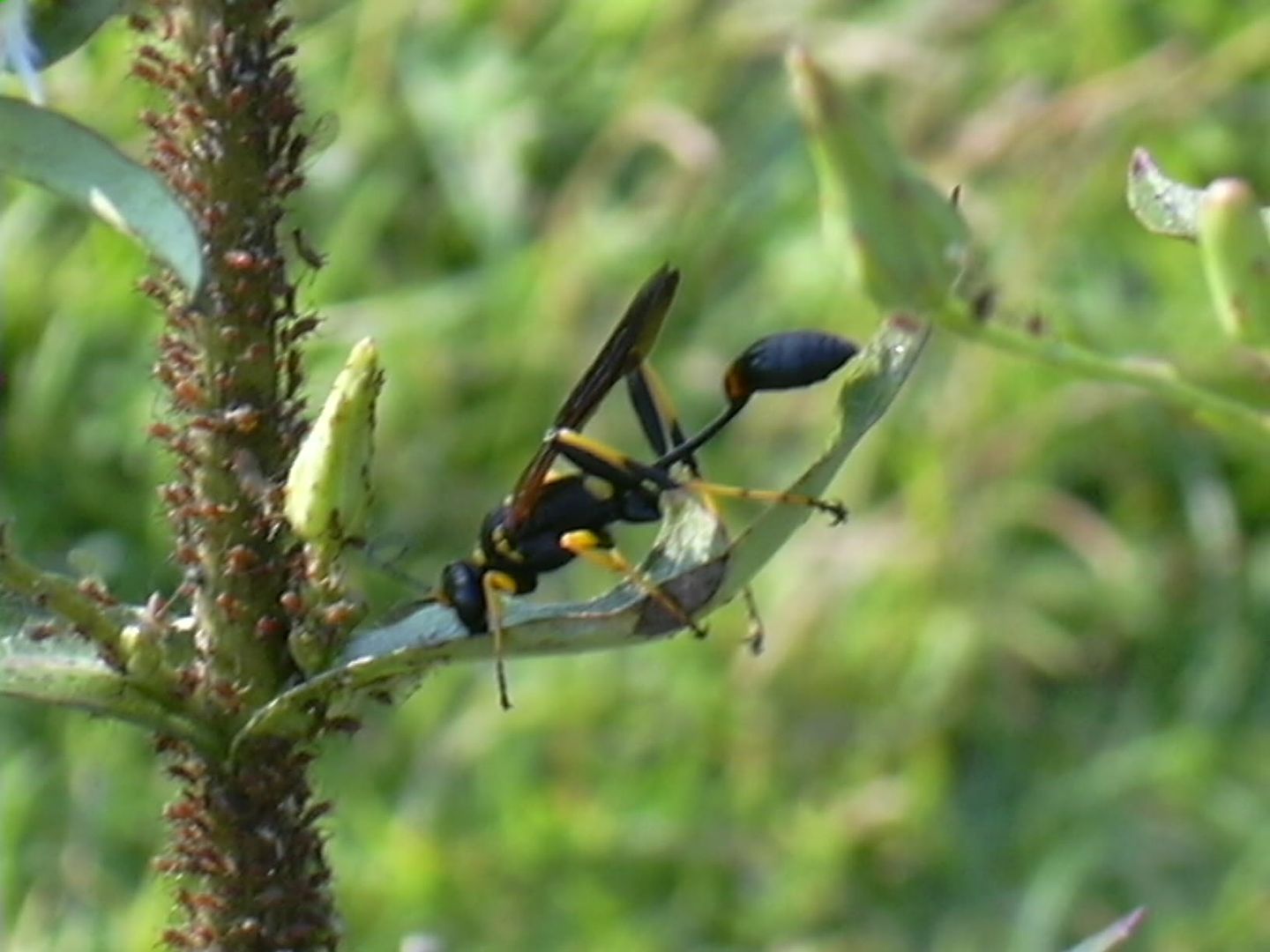
Wasps, Aphids natural enemy


Digg Technorati del.icio.us Stumbleupon Reddit Blinklist Furl Spurl Yahoo Simpy

Weather Monitoring


Blogger Templates. Sponsored by SEO Expert

Previews & Insights On New Products, Cool Gadgets & Latest Inventions Previews & Insights On New Products, Cool Gadgets & Latest Inventions Previews & Insights On New Products, Cool Gadgets & Latest Inventions Previews & Insights On New Products, Cool Gadgets & Latest Inventions Previews & Insights On New Products, Cool Gadgets & Latest Inventions Previews & Insights On New Products, Cool Gadgets & Latest Inventions